
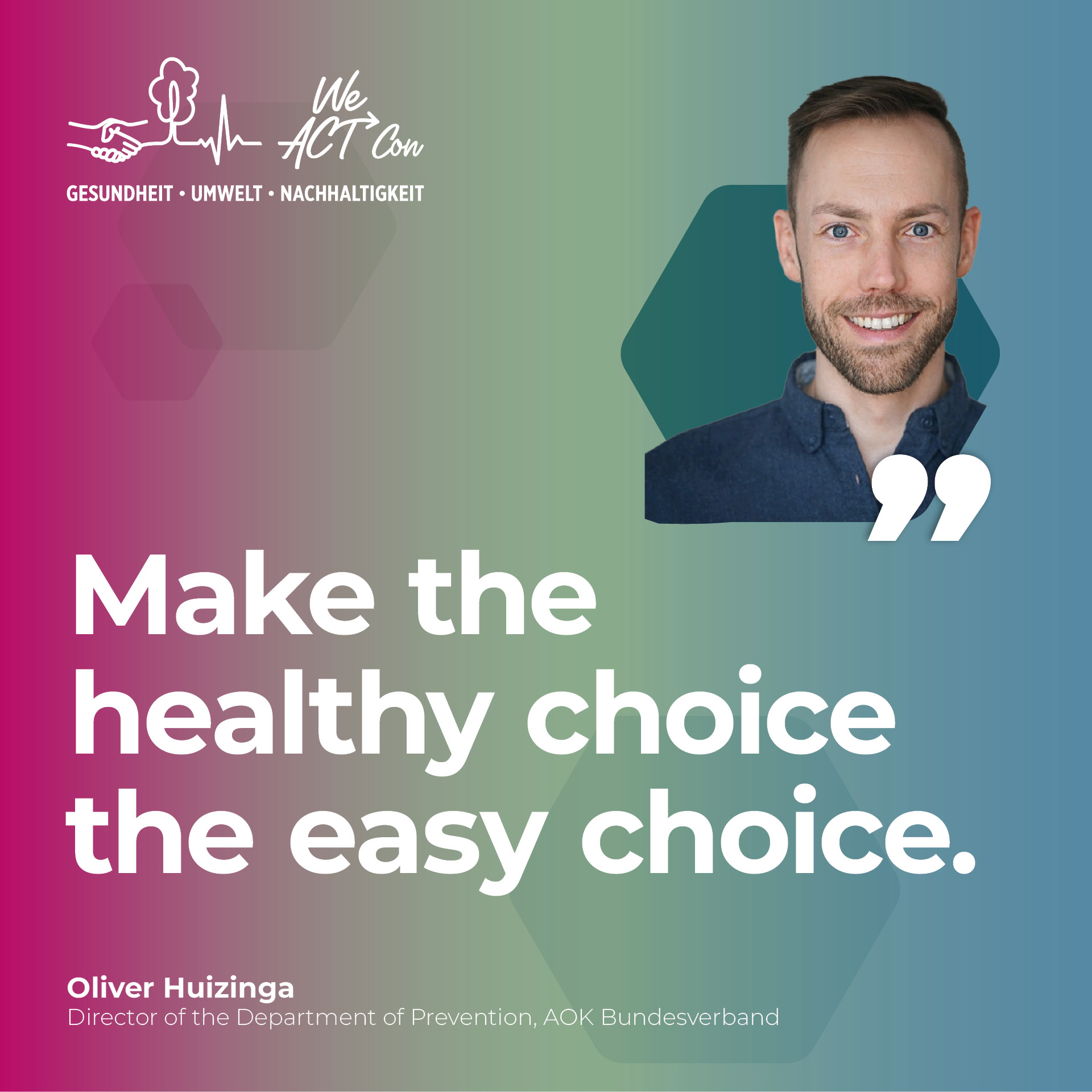
Interview with Oliver Huizinga
"The healthy choice hast o be the easy choice"
What does climate change have to do with cardiovascular disease? And why does almost every second person in Germany die from preventable causes? Oliver Huizinga, Head of the Prevention Department at the AOK Federal Association, calls for a rethink - in the healthcare system and in politics.
Interview: WeACT Con
1
Mr Huizinga, Germany spends a lot of money on health compared to other European countries. Despite this, life expectancy is below average. How does that fit together?
Oliver Huizinga: One of the main reasons for this is the high burden of disease caused by so-called non-communicable diseases - diseases such as diabetes, obesity, cardiovascular diseases and cancer. The good news is that a large proportion of this burden of disease is behaviour-related and can therefore be influenced. Studies show that four out of ten deaths in Germany can ultimately be attributed to just four risk factors: Smoking, an unhealthy diet, lack of exercise and alcohol. This shows the enormous potential of preventive measures - but also how much we have so far neglected.
2
Why does Germany find prevention so difficult?
We are lagging behind, especially when it comes to the political framework conditions. Where economic interests are affected - for example in the tobacco, alcohol or food industries - Germany is particularly hesitant. Other countries have long since taken structural measures: Advertising restrictions, incentive taxes, better labelling. In Germany, the lobbying of these industries is unfortunately very successful - to the detriment of public health and ultimately the economy. This should actually be the case: The common good must take precedence over commercial vested interests.
3
What role does climate change play in this context?
In this country, heat is the greatest health risk directly linked to climate change. In hot summers, we already see an excess mortality rate of around 10,000 people in the data. Measured against this, however, awareness among the population is still inadequate and it is misjudged as a shallow issue. The issue of heat is a particularly clear example of co-benefits: effective climate protection is health protection. And vice versa: many measures to protect the climate also have a direct health-promoting effect.
4
Can you give an example of this?
Exercise in everyday life is a good example. If people walk, cycle or use public transport more often, this is not only good for their individual health, but also reduces emissions. Or nutrition: eating less meat and sausage promotes health and at the same time conserves resources and protects the climate. The environment and health are closely linked.
5
What responsibility does the healthcare system itself bear?
If we succeed in significantly improving the health of the population through a smart prevention policy, this will have a direct impact on the ecological footprint of the healthcare system. It may sound banal, but avoided illnesses also mean avoided treatments, avoided operations, avoided medicines, avoided aids, avoided journeys - in other words, everything that makes up the footprint of the healthcare system in the first place.
6
What would have to change structurally for prevention to work better?
Successful prevention must start at many levels, in line with the health-in-all-policies approach. Many people want to adopt healthier behaviour. However, they find it difficult to implement this in their everyday lives. For example, it has never been easier to eat too much of the wrong things and hardly exercise. The healthy choice must become the easier choice. This can be achieved through health-promoting framework conditions: safe footpaths and cycle paths, healthy school and nursery meals, advertising restrictions for unhealthy products or incentive taxes are great levers. The health insurance companies can provide impetus, bring offers to increase health literacy in the area and provide education - but the framework conditions are ultimately determined by politics.
7
And how do you assess the current political situation?
Unfortunately, the topic of prevention was only a side note in the coalition negotiations. The CDU/CSU and SPD have failed to recognise the overriding relevance of the avoidably high burden of disease for the solidarity systems and the national economy. Above all, there is a lack of a public health strategy aimed at promoting healthy living conditions. Furthermore, no concrete, promising measures to curb smoking, alcohol and promote a healthier diet are foreseeable. Politically, the strategy seems to be to first make people ill and then treat them at great expense. My thesis is that it is only a matter of time before the realisation sets in that we cannot afford this strategy in the long term.
Oliver Huizinga is Head of Prevention at the AOK Federal Association and one of many exciting WeACT Con speakers.